

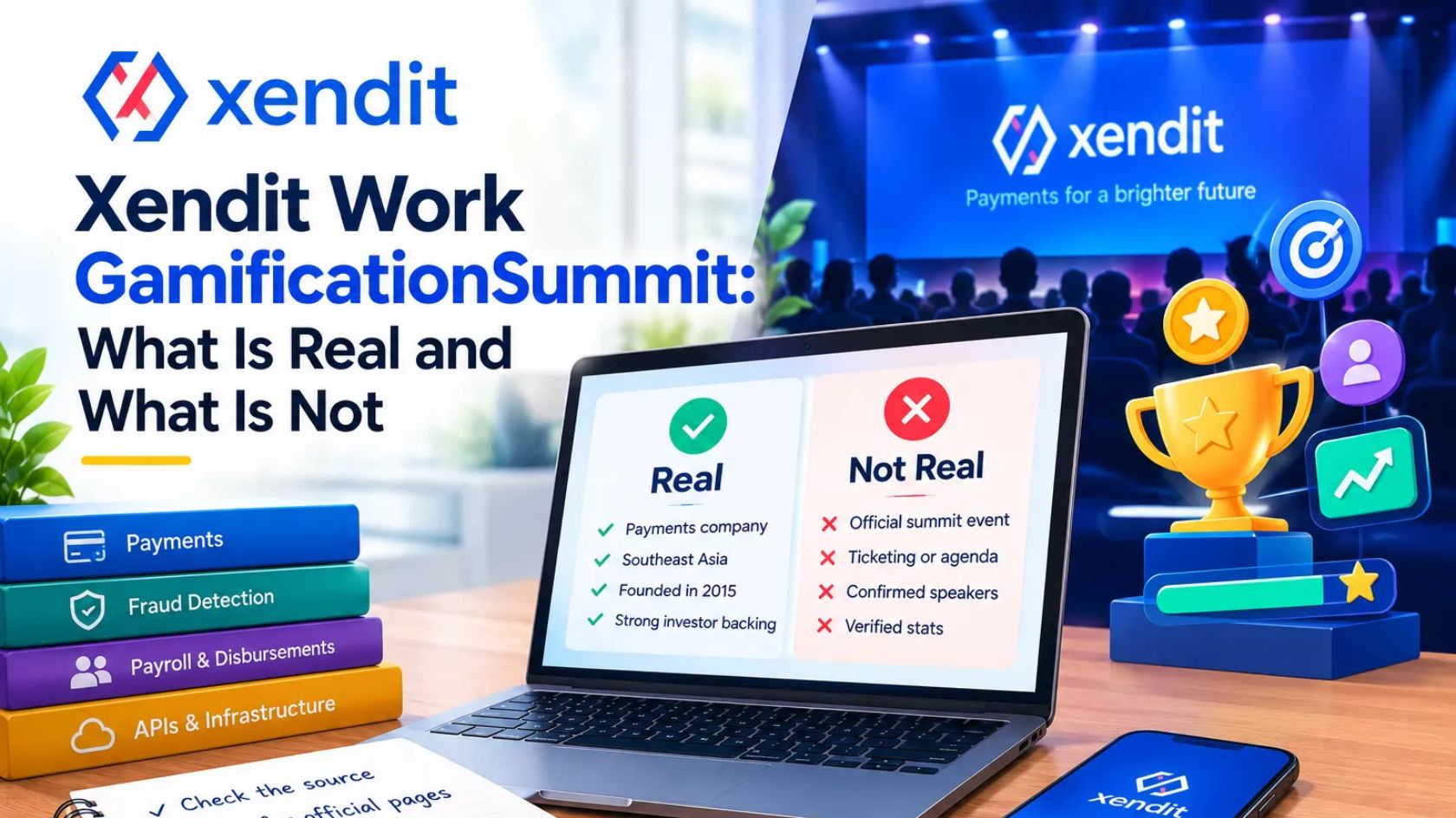
Xendit Gamification Summit Work is a search phrase that brings together three growing topics: Xendit, workplace gamification, and summit-style learning. However, there is an important distinction for anyone researching the subject in 2026. Xendit publicly documents its payment infrastructure, company culture, careers, and events, but its official public events page does not currently identify a program called the “Xendit Gamification Summit.”
That means the most reliable way to understand this topic is to separate verified Xendit information from broader workplace-gamification concepts and unverified online claims. This guide explains what the phrase means, why gamification matters at work, how a responsible gamification framework can operate, which technologies can support it, and how U.S. businesses can measure results without confusing activity with real business impact.
What Is Xendit Gamification Summit Work?
The phrase Xendit Gamification Summit Work does not currently appear to be the confirmed public name of a Xendit product or official workplace program. Xendit describes itself as a fintech company that provides digital payment infrastructure, including tools for accepting payments, sending payouts, and managing financial workflows. Its official events platform, xentalks, lists business and community events, but the publicly listed events do not include a Gamification Summit under that name.
This distinction is important for SEO content and for readers who want trustworthy information. Several third-party websites describe a supposed 2026 summit in detail, including workshops, scoring systems, pilots, and business results. Those claims should not automatically be treated as confirmed Xendit case studies unless supported by an official Xendit announcement or primary documentation. The underlying subject—workplace gamification—is legitimate, however, and can be examined independently.
In practical terms, workplace gamification means applying selected game-design elements to normal business activities. These can include points, progress indicators, challenges, badges, recognition, feedback loops, and carefully designed rewards. A good system does not turn every employee task into a game. Instead, it uses motivational mechanics where they can support a clearly defined business or learning goal.
Why Workplace Gamification Has Gained Attention
Workplace gamification has attracted attention because organizations are looking for ways to make routine activities more engaging without abandoning business objectives. A 2025 systematic review examined 56 studies involving games and gamification in areas such as organizational learning, employee engagement, collaboration, HR, management, and training. The research shows that gamification is a serious area of organizational study rather than simply a trend borrowed from consumer games.
The strongest approach is not “make work fun at any cost.” Instead, companies should identify a behavior they want to encourage and then select a game mechanic that supports it. For example, a progress bar may help employees complete training, while team challenges may encourage cross-functional participation. The design should remain voluntary or appropriately integrated into work, transparent, accessible, and aligned with employee needs.
Employee Motivation and Engagement
Gamification can create visible progress and short feedback cycles. An employee who can see completed milestones may have a clearer sense of movement toward a goal than someone working with an abstract annual target. Recent research on gamified human-resource management found a positive relationship between gamification and employee engagement, with intrinsic motivation playing a mediating role.
However, motivation should not depend entirely on points or prizes. Employees also need autonomy, competence, recognition, meaningful work, and supportive management. A leaderboard cannot compensate for unclear expectations or poor workplace culture. For that reason, gamification should strengthen good management practices rather than replace them.
Collaboration and Team Participation
Team-based challenges can shift attention from individual performance toward shared outcomes. Instead of rewarding only the employee who completes the most tasks, a company might recognize a department for completing a training milestone together or solving a customer-service problem collaboratively.
This approach can be particularly useful for distributed and hybrid teams. Shared goals create a common activity without requiring everyone to be in the same office. Still, competition needs boundaries. If rankings create embarrassment or encourage employees to manipulate metrics, the system can reduce trust instead of improving it.
Learning and Skill Development
Training is one of the most practical areas for gamification. Employees can complete short missions, earn progress markers, answer knowledge checks, and unlock increasingly difficult scenarios. This structure can make lengthy learning programs easier to navigate.
A 2025 study on workplace gamification and training emphasizes the importance of theoretical foundations such as self-determination theory when designing learning experiences. The lesson is straightforward: successful gamified learning should support competence and motivation, not merely add decorative badges to an existing course.
How the Xendit Gamification Framework Works
Because a formal public Xendit gamification framework is not documented in Xendit’s current public materials, the mechanics below should be understood as a practical workplace-gamification model, not as an official Xendit system. This distinction protects accuracy while still addressing what readers searching for Xendit Gamification Summit Work are likely trying to understand.
A sound framework begins with an objective. The organization decides whether it wants to improve onboarding, learning completion, collaboration, customer-service behaviors, product adoption, or another measurable outcome. Only then should it select points, challenges, recognition, or rewards. This reverses a common mistake: starting with a game mechanic and searching for a business problem afterward.
Daily Wins and Progress Tracking
Small milestones can make long projects easier to understand. A dashboard might show training modules completed, team objectives reached, or customer-service learning milestones achieved. The purpose is to provide useful feedback rather than create surveillance.
Progress tracking should also be meaningful. If employees receive points simply for being online or attending meetings, the metric may become disconnected from value. Better systems reward behaviors that contribute to an established objective.
Collaborative Challenges
Collaborative challenges can ask teams to complete a shared target within a defined period. For example, a customer-success team could work together to complete a product certification, while a sales team could collaborate on a knowledge-sharing challenge.
Team mechanics also reduce some of the problems associated with individual leaderboards. Employees can contribute in different ways, and success does not depend entirely on being the fastest person in the group.
Smart Challenges and Activities
Effective challenges are specific, measurable, and achievable. A challenge such as “improve teamwork” is difficult to measure. “Complete three cross-team knowledge exchanges this month” is much easier to define and assess.
Adaptive systems can also vary difficulty. New employees might receive introductory activities, while experienced employees receive more advanced tasks. This prevents the program from becoming either too difficult for beginners or too easy for experienced participants.
Meaningful Rewards and Recognition
Rewards can include public recognition, professional-development opportunities, small benefits, team celebrations, or monetary incentives where appropriate. The best reward depends on the behavior being encouraged and the organization’s culture.
Recognition is especially important because not every valuable behavior should have a financial price. A thoughtful acknowledgment from a manager or peer can reinforce contribution without turning every workplace interaction into a transaction.
Technology Behind Workplace Gamification
Modern gamification platforms can combine employee profiles, learning systems, dashboards, analytics, messaging, and reward tools. However, technology should remain secondary to the behavioral design. A sophisticated dashboard cannot fix poorly chosen goals.
Xendit’s own technology has a different primary purpose. Its official documentation describes payment acceptance, payouts, APIs, integrations, and financial infrastructure. Therefore, Xendit should not be described as a workplace-gamification platform simply because its payment infrastructure could potentially support monetary reward workflows.
AI and Personalization
AI can help personalize challenges based on role, skill level, progress, or learning needs. For example, an employee who has already mastered a basic topic could receive a more advanced scenario rather than repeating beginner material.
The key risk is over-personalization. Employees should understand how data is being used and should not feel that every action is being scored by an invisible system. Transparency and privacy should therefore be part of the design from the beginning.
Analytics and Progress Tracking
Analytics allow managers to compare participation with actual outcomes. Useful measures might include course completion, time to proficiency, task completion, quality scores, or customer outcomes.
Companies should avoid vanity metrics. A dashboard showing thousands of points does not prove that the program improved performance. The important question is whether the targeted business or learning outcome changed.
Digital Rewards and Integrations
Digital reward systems can connect achievement rules with recognition or payout workflows. Xendit’s documentation, for example, describes payout infrastructure capable of programmatically sending funds through its APIs. That could make payment infrastructure relevant to a reward workflow, but it does not make Xendit itself a gamification engine.
For U.S. organizations, any monetary employee-reward program also needs appropriate attention to payroll, tax, employment, privacy, and incentive-program requirements. Those details should be reviewed with qualified legal, tax, and HR professionals before launch.
How to Implement a Workplace Gamification Strategy
A successful program should begin with a narrow business problem. Companies should avoid launching a company-wide points system before knowing what behavior they want to influence. A focused pilot provides a safer way to test assumptions, collect employee feedback, and determine whether gamification adds measurable value.
The approach also fits an experimental culture. Xendit’s public company materials emphasize growth, customer focus, trust, and continuous learning. Those publicly documented values can provide useful context for discussing how a company culture might support experimentation, although they should not be presented as evidence of a specific gamification program.
Planning and Goal Setting
Start with one objective and one primary metric. For example, a company might want to increase completion of mandatory security training without reducing knowledge quality.
Define the target audience, rules, duration, measurement method, privacy considerations, and success threshold before launch. Employees should understand exactly how participation works.
Running a Pilot Program
A pilot might involve one department or a limited employee group. Keep the mechanics simple enough that participants can understand them without extensive training.
Compare results against a baseline whenever possible. If the gamified group performs better, investigate why. If results do not improve, change the design rather than assuming employees were the problem.
Launching Across the Organization
A wider rollout should include clear communication, manager training, accessibility checks, and support for employees who prefer different ways to participate.
The program should also work across locations and job functions. A U.S.-based company with remote employees, for instance, should ensure that participation does not depend on being physically present at headquarters.
Measuring and Optimizing Results
After launch, monitor both engagement and business outcomes. Look for changes in completion, quality, collaboration, learning, productivity, and employee sentiment.
Optimization should be continuous. Remove mechanics that create unwanted behavior, simplify confusing rules, and adjust rewards when they lose relevance.
Potential Benefits of Workplace Gamification
Workplace gamification can make progress more visible and create faster feedback loops. It may also provide structure for learning and encourage employees to participate in activities that are otherwise easy to postpone.
The potential benefits depend heavily on implementation. Gamification is not a universal productivity solution, and research suggests that outcomes can depend on motivation, organizational support, individual preferences, and the specific design of the system.
Employee Engagement
Employees can receive immediate feedback about progress instead of waiting for an annual review. That can make certain learning or participation goals feel more concrete.
Collaboration and Team Building
Team missions can encourage communication across departments. When designed well, they can create shared goals without making employees compete against colleagues for limited rewards.
Learning and Development
Gamified learning can break complex training into smaller activities. Progress indicators and challenges can also encourage employees to return to learning programs.
Productivity and Participation
Gamification may increase participation in selected workflows when the mechanic is closely connected to the desired behavior. The important qualification is that increased activity does not automatically equal increased productivity.
Measuring the Success of Workplace Gamification
Measurement should begin before implementation. Establish a baseline and decide which indicators matter. Otherwise, companies can mistake high participation for success.
A strong evaluation combines quantitative and qualitative information. Completion rates can show what employees did, while surveys and interviews can help explain why they did it and whether the experience was useful.
Participation Rates
Track registration, active participation, completion, repeat engagement, and drop-off. These figures show whether employees actually use the system.
Engagement Metrics
Consider employee feedback, voluntary participation, learning activity, recognition activity, and satisfaction scores. Avoid treating clicks or points as direct evidence of engagement.
Productivity Indicators
Depending on the program, productivity indicators may include cycle time, quality, customer response time, error rates, learning proficiency, or project completion.
Retention and Employee Feedback
Longer-term measures can include retention trends, internal mobility, employee sentiment, and qualitative feedback. These should be interpreted carefully because many factors influence employee retention.
Challenges of Implementing Workplace Gamification
Gamification can fail when employees see it as forced competition or another layer of workplace administration. Poorly designed systems can also encourage gaming the metric rather than improving the underlying behavior.
The solution is not necessarily to eliminate competition. Instead, organizations should design transparent mechanics, offer meaningful choices, and regularly ask participants whether the experience helps them do their work.
User Adoption
Employees may ignore a system that adds work without providing clear value. Adoption improves when the program is simple and directly connected to useful outcomes.
Reward Fatigue
The same reward loses impact over time. Organizations should refresh recognition while avoiding an endless cycle of increasingly expensive incentives.
Balancing Competition and Collaboration
Leaderboards can motivate some employees but discourage others. Team-based goals, personal progress indicators, and optional recognition can provide a more balanced model.
Maintaining Long-Term Engagement
Novelty eventually fades. Sustainable gamification depends on meaningful goals, good content, useful feedback, and periodic redesign—not endless points and badges.
Lessons Businesses Can Learn From Xendit
The safest lessons from Xendit come from its publicly documented business and culture materials rather than unverified claims about a Gamification Summit. Xendit identifies values including being customer-focused, trustworthy, growth-oriented, and collaborative. Its company materials also emphasize learning and development.
Those principles provide a useful framework for evaluating workplace gamification. A successful program should make work clearer, help people develop, support trust, and connect activities to customer or organizational value.
Keep Participation Natural
Do not gamify every meeting, email, or task. Choose activities where progress, feedback, or challenges genuinely improve the experience.
Reward Meaningful Behaviors
Rewards should reinforce behaviors that matter. Completing meaningless activities for points can create impressive dashboards while producing little business value.
Prioritize Collaboration
Use team challenges when the work itself depends on cooperation. This can help gamification reinforce rather than undermine workplace relationships.
Listen to Employee Feedback
Employees should have a meaningful opportunity to explain what works and what does not. Feedback is especially important during pilot programs.
Focus on Experience Alongside KPIs
Business metrics matter, but employee experience matters too. A program that improves one KPI while creating stress, distrust, or unhealthy competition may not be sustainable.
Workplace Gamification Use Cases Across Industries
Gamification can be adapted to many sectors. In technology companies, it can support developer learning, security awareness, onboarding, or knowledge sharing. Financial-services organizations can use simulations and challenges for compliance education. Retail businesses can build sales-training missions, while healthcare organizations can use structured learning activities for professional development.
Manufacturing teams may apply gamification to safety training, quality improvement, or process learning. Universities and professional-training organizations can use progress systems to support course completion. In each case, the design should reflect the work rather than forcing the work into a generic game template.
For U.S. companies, accessibility, employment practices, data privacy, and incentive rules should also be considered. Gamification should be inclusive enough for employees with different abilities, work styles, locations, and levels of technology access.
The Future of Workplace Gamification
The next stage of workplace gamification is likely to be less about flashy leaderboards and more about adaptive experiences. Organizations increasingly have access to learning systems, workforce analytics, collaboration tools, and AI capabilities that can personalize content and feedback.
At the same time, businesses are becoming more cautious about employee data. Future systems will need to balance personalization with transparency. The best workplace-gamification programs will likely be those that employees understand, trust, and find genuinely useful.
AI-Driven Personalization
AI can recommend challenges, learning paths, or feedback based on employee progress. This can reduce repetitive training and make development more relevant.
Predictive Engagement
Analytics may help identify where employees are dropping out of learning programs or where participation is declining. Such insights can guide program improvements before engagement collapses.
Gamified Learning
Learning remains one of the strongest use cases. Short challenges, simulations, progress paths, and knowledge checks can support continuous development when the content itself is valuable.
Hybrid Workplace Experiences
Hybrid organizations need activities that work equally well for remote and office-based employees. Digital challenges and shared progress dashboards can create common experiences without requiring physical proximity.
Frequently Asked Questions
What Is Xendit Gamification Summit Work?
Xendit Gamification Summit Work is a search phrase connecting Xendit, gamification, and workplace activity. Xendit’s current public event listings do not clearly establish a formal event or product with that exact name.
How Does Workplace Gamification Improve Employee Engagement?
It can provide visible progress, short feedback loops, recognition, and meaningful challenges. Research suggests gamified HR practices can support engagement, although results depend on design and organizational context.
Can Small Businesses Implement Workplace Gamification?
Yes. Small businesses can begin with simple tools such as team challenges, progress trackers, learning milestones, and peer recognition. A small pilot is usually easier to manage than a complex company-wide platform.
Why Can Collaboration Be Important in Workplace Gamification?
Collaboration helps prevent gamification from becoming a purely individual competition. Team goals can encourage knowledge sharing, cross-functional work, and collective responsibility.
How Can Companies Measure Gamification Results?
Companies can compare participation, engagement, productivity, learning, quality, and employee-feedback metrics against a baseline. The most useful measures are directly connected to the original business objective.
What Challenges Can Companies Face When Implementing Gamification?
Common challenges include low adoption, reward fatigue, unhealthy competition, privacy concerns, poor metric design, and declining interest after the initial novelty disappears. Simple rules and regular feedback can reduce these risks.
Conclusion
Xendit Gamification Summit Work is best approached as a search topic rather than a confirmed Xendit product or publicly documented workplace program. Xendit’s official materials clearly establish the company as a payments and financial-infrastructure provider, while its public events platform documents business and community events. They do not currently provide clear primary-source confirmation of a formal “Gamification Summit” under that name.
The broader workplace-gamification concept, however, is well established. Points, challenges, progress tracking, recognition, collaborative goals, and personalized learning can support employee engagement when they are tied to meaningful outcomes. For businesses in the U.S. and beyond, the best strategy is to start small, measure real results, protect employee trust, and optimize based on evidence. That approach makes gamification a practical workplace tool rather than a short-lived novelty.

Sophia Mitchell is a US-based author known for inspiring stories blending emotion, clarity and modern themes of life, hope and growth worldwide bio