

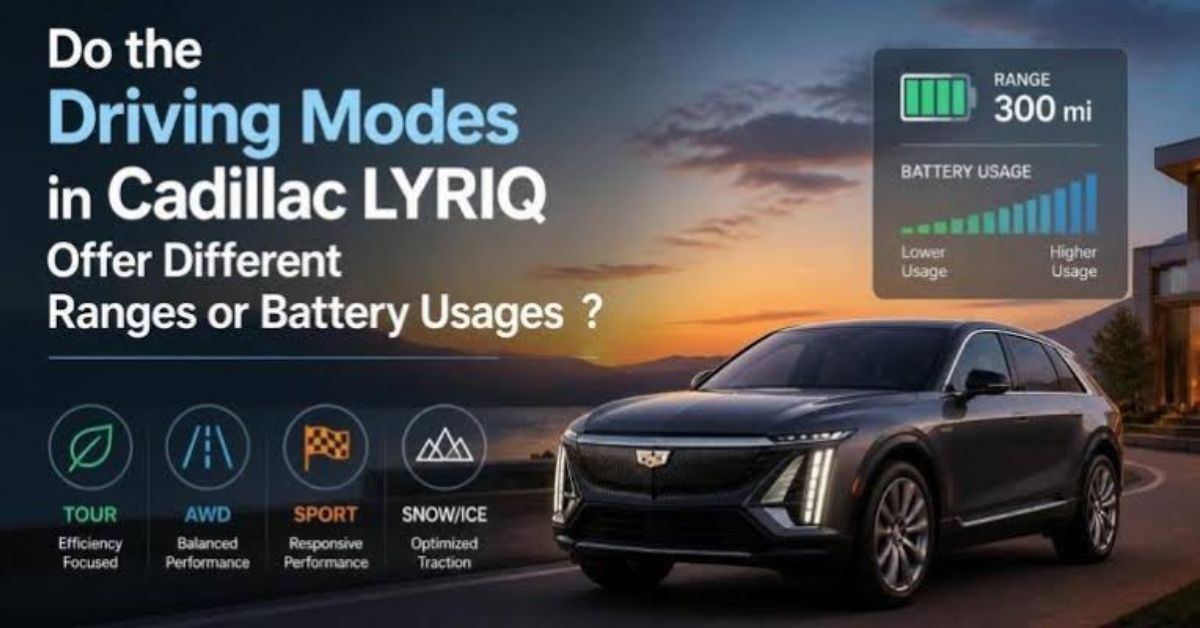
The Cadillac LYRIQ gives drivers several ways to change how the SUV feels on the road, but that does not mean every driving mode comes with a separate EPA range rating. So, do the driving modes in Cadillac LYRIQ offer different ranges or battery usages? The practical answer is more nuanced. Tour, Sport, Snow/Ice, and My Mode change how the vehicle responds to accelerator input, steering, braking, and other systems. Those changes can affect real world energy consumption, especially when they encourage stronger acceleration or different driving habits. However, Cadillac does not publish a separate EPA range figure for each standard driving mode.
This guide explains what each mode actually changes, why Sport can consume more energy during aggressive driving, how regenerative braking fits into the equation, and why drivetrain choice can matter more than the mode selected. It also covers practical ways LYRIQ owners can improve efficiency without giving up the features they enjoy.
Quick Bio Table
| Feature | 2026 Cadillac LYRIQ detail |
| Vehicle type | All electric midsize SUV |
| Battery | 102 kWh rated energy capacity |
| RWD range | Up to 326 miles EPA estimated |
| AWD range | Up to 319 miles with standard 11.5 kW charging configuration |
| AWD range | Up to 303 miles with available 19.2 kW charging configuration |
| Standard driving modes | Tour, Sport, Snow/Ice and My Mode |
| Regeneration | Regen On Demand and One Pedal Driving |
| Battery platform | GM Ultium based architecture |
| Seating | Two rows, five passengers |
Cadillac lists the 2026 LYRIQ’s battery at 102 kWh and gives different EPA estimated ranges depending on the powertrain and charging configuration. These published figures should not be confused with mode specific range numbers.
What Do the LYRIQ Driving Modes Actually Change?
The LYRIQ’s driving modes are primarily about vehicle response and driving character. Cadillac describes Tour as the predominant everyday setting, with tuning intended to provide a smooth ride. Sport is calibrated for a stronger feeling of road connection, more immediate torque response, and enhanced steering response. Snow/Ice is designed to help reduce wheel spin by changing pedal and torque response. My Mode lets the driver customize selected characteristics.
That distinction is important when thinking about battery consumption. A mode does not simply tell the battery to release a fixed amount of energy every mile. Instead, it changes how the vehicle responds to the driver’s inputs and road conditions. A gentle driver could select Sport and still drive efficiently on a steady highway. Another driver could select Tour but repeatedly accelerate hard. Their energy consumption could therefore look very different.
The mode is one factor inside a much larger efficiency picture. Vehicle speed, elevation changes, outside temperature, HVAC use, tire pressure, payload, wind, traffic, and acceleration patterns can all influence how many kilowatt hours the LYRIQ uses.
Does Tour Mode Provide Better Range?
Tour is the LYRIQ’s everyday driving mode and is designed around a smooth, balanced driving experience. Cadillac describes it as the predominant mode for normal driving, rather than as a separate long range setting with its own EPA rating.
In normal conditions, Tour can make it easier to drive efficiently because its response is intended to be smooth and predictable. That can help a driver avoid unnecessary bursts of acceleration. However, it would be misleading to say that Tour automatically guarantees a specific number of extra miles.
Real world range depends on the complete trip. A LYRIQ traveling steadily at moderate highway speeds in mild weather may consume less energy than the same vehicle making repeated high speed accelerations in traffic. Even within Tour mode, those differences can be substantial.
For range focused driving, the useful approach is to treat Tour as a comfortable everyday setting rather than a magic battery saving switch. Smooth inputs, steady speeds, proper tire pressure, and moderate climate control settings usually matter more than simply selecting a mode.
Can Sport Mode Use More Battery?
Sport mode can contribute to higher energy consumption, particularly when the driver takes advantage of its more immediate response. Cadillac says Sport provides more immediate torque response and a stronger road connection. In an electric vehicle, repeated hard acceleration requires substantial electrical power, even though electric motors are highly efficient.
This does not mean Sport mode automatically drains the battery at a fixed faster rate. If you activate Sport but drive gently, the difference may be relatively small. If you use it for rapid acceleration, spirited cornering, or frequent high power events, consumption can increase because more energy is being requested from the battery.
A useful way to think about it is this: Sport changes the opportunity for performance; your driving determines how much of that performance you use. The same principle applies to many EVs. Instant electric torque makes aggressive acceleration particularly noticeable on the energy display.
Sport mode also does not permanently damage or reduce the battery’s capacity simply because it is selected. Normal vehicle controls manage power delivery and battery operation within the system’s designed limits.
What About Snow/Ice Mode?
Snow/Ice mode has a different purpose. Cadillac says this mode is intended to help prevent wheel spin on slippery surfaces by adjusting the pedal map and slowing acceleration and torque response.
Because the mode is designed around traction rather than maximum performance, it may change how quickly the vehicle responds to accelerator input. That can sometimes help produce smoother starts on snow or ice. However, it should not be treated as a guaranteed range saving mode.
Winter driving itself can reduce EV range. Cold temperatures affect battery performance, cabin heating requires energy, and snow or slush can increase rolling resistance. In addition, roads may require more frequent acceleration and braking. Therefore, if you see lower efficiency in winter, the cause may have much more to do with weather and road conditions than the Snow/Ice setting alone.
The purpose of Snow/Ice mode is controlled traction and predictable response. Range should be a secondary consideration when road grip is limited.
Does My Mode Affect Battery Consumption?
My Mode is designed for personalization. Cadillac says it allows the LYRIQ driver to change characteristics such as accelerator responsiveness, steering feel, braking responsiveness, and Electric Vehicle Sound Enhancement.
Because some of these settings influence how the vehicle responds to the driver’s inputs, My Mode can indirectly affect efficiency. A more responsive accelerator calibration may make strong acceleration easier to request. A calmer configuration may encourage smoother driving. Still, the mode itself does not establish a fixed battery consumption rate.
The most important question is which settings you select and how you use them. If you configure My Mode for a comfortable response and maintain steady speeds, it can be perfectly compatible with efficient driving. If your settings make performance more accessible and you frequently use that performance, energy consumption can rise.
That is why there is no universal My Mode range number. Your configuration and driving conditions matter.
Why Driving Style Matters More Than the Mode Name
The biggest mistake when comparing LYRIQ modes is focusing only on the name displayed on the screen. Energy consumption is strongly connected to what the vehicle is physically doing. Hard acceleration requires more electrical power. High speeds increase aerodynamic losses. Repeated stop and go driving creates more opportunities for energy conversion through braking.
A smooth driver can often make a bigger difference than switching between two reasonable drive modes. Maintaining a consistent speed, anticipating traffic, avoiding unnecessary acceleration, and using regeneration effectively can all help reduce wasted energy.
The environment matters too. A cold winter morning can produce a different efficiency result from a mild afternoon. A long uphill climb uses more energy than a flat route, while descending can allow regenerative braking to recover some energy.
For that reason, when asking do the driving modes in Cadillac LYRIQ offer different ranges or battery usages?, it is better to compare complete driving conditions instead of looking for a single mode that supposedly delivers the most miles.
Can Regenerative Braking Improve Range?
Regenerative braking can help improve overall efficiency because the electric motor can act as a generator during deceleration. Instead of converting all braking energy into heat through conventional friction brakes, the system can recover some energy and send it back toward the battery.
Cadillac offers both One Pedal Driving and Regen On Demand on the LYRIQ. The company explains that Regen On Demand uses the electric motor to slow the vehicle while simultaneously charging the battery.
However, regeneration does not create free energy. Energy is lost during every conversion, so the best strategy is still to avoid unnecessary acceleration in the first place. Regeneration is especially useful when slowing for traffic, descending hills, or approaching stops where deceleration is already required.
Cadillac also notes that regenerative features can be affected when the battery is very full or extremely hot or cold. Drivers should therefore use the brake pedal when necessary and follow the owner’s manual guidance.
Does All-Wheel Drive Change the Answer?
Yes. Drivetrain configuration can have a more obvious effect on official range than simply changing the driving mode. For 2026, Cadillac lists the single motor RWD LYRIQ at up to 326 miles of EPA estimated range. The dual motor AWD version is listed at up to 319 miles with the standard 11.5 kW charging configuration, while the available 19.2 kW configuration is listed at 303 miles.
The AWD system adds a second motor and changes the vehicle’s powertrain configuration. That can affect efficiency and range. It does not mean AWD is inefficient in every situation; traction requirements, weather, tires, and driving conditions also matter.
It is therefore useful to separate two questions. Driving modes change how the vehicle behaves. Drivetrain configuration changes the hardware doing the work. When comparing range figures, always compare the same model year, drivetrain, wheel and tire setup, and other relevant specifications.
The LYRIQ-V is another example. Cadillac lists a separate 285 mile EPA estimated range for the high performance dual motor AWD model.
Does Sport Mode Permanently Reduce Battery Life?
No evidence in Cadillac’s published information indicates that simply selecting Sport mode permanently reduces the LYRIQ battery’s usable life. Sport mode is a factory designed driving setting, not an overdrive modification or aftermarket battery adjustment.
Battery longevity is influenced by many factors, including temperature, charging behavior, time spent at high or low states of charge, mileage, and normal battery aging. Cadillac specifically recommends charging to 80% for daily use in its Regen On Demand guidance, leaving additional room for regenerative braking, while allowing a higher charge for longer trips.
That does not mean owners must avoid Sport mode. If you enjoy the sharper response, it is a normal feature of the vehicle. The practical consideration is energy consumption during performance driving, not a claim that Sport mode itself permanently damages the battery.
As always, the owner’s manual for the exact model year and configuration should take priority over general advice.
How Can LYRIQ Owners Get the Best Range?
Start with the basics. Keep tire pressures at the recommended levels, avoid unnecessary cargo, maintain a steady speed when traffic permits, and accelerate smoothly. Highway speed deserves particular attention because aerodynamic resistance increases rapidly as speed rises.
Use the LYRIQ’s energy information to learn what is happening on your own routes. Instead of assuming that one mode is always better, compare similar trips under similar conditions. Look at energy consumption, outside temperature, average speed, elevation, and HVAC use.
Regenerative braking can also help recover energy during normal deceleration. Cadillac provides One Pedal Driving and Regen On Demand for this purpose.
For longer trips, Cadillac’s route planning tools can help with charging strategy. The company says its in vehicle Google built in route planning can show charging locations and estimated battery level at arrival, while Fast Charge Prep can condition the battery for quicker DC charging when appropriate.
How Should You Compare Different Driving Modes?
A fair comparison requires more than switching modes and looking at the battery percentage afterward. Start with the same route, similar starting state of charge, similar weather, similar tire pressure, and similar traffic conditions. Then compare energy consumption over several trips rather than relying on one drive.
For example, you could drive the same daily commute in Tour and then in Sport while keeping acceleration and speed as similar as possible. If the results differ, repeat the test. A single trip can be distorted by traffic lights, wind, temperature, or elevation.
You should also separate mode effect from driving behavior. If Sport makes you accelerate harder, the resulting higher energy use is partly a consequence of how the vehicle is being driven. If Tour encourages smoother inputs, its efficiency advantage may reflect driving behavior rather than a fundamentally different battery efficiency setting.
There is no official Cadillac table showing a fixed EPA range for Tour, Sport, Snow/Ice, and My Mode. Cadillac’s published EPA figures are tied to vehicle configurations rather than individual standard drive modes.
FAQs
Does Sport mode reduce Cadillac LYRIQ range?
Sport mode can increase real world energy use when its quicker response leads to stronger acceleration or spirited driving. Cadillac does not publish a separate Sport mode EPA range.
Is Tour mode the most efficient Cadillac LYRIQ setting?
Tour is designed for everyday driving and smooth response. It can support efficient driving, but actual range still depends on speed, temperature, terrain, HVAC use, traffic, and driving style.
Does Snow/Ice mode save battery on the LYRIQ?
Snow/Ice mode is designed primarily for traction on slippery roads. It changes accelerator and torque response rather than serving as a dedicated battery saving mode.
Does regenerative braking increase LYRIQ driving range?
Regenerative braking can recover some energy during deceleration and help overall efficiency. It cannot recover all the energy used for acceleration, so smooth driving remains important.
Does LYRIQ AWD have less range than RWD?
For the 2026 LYRIQ, Cadillac lists up to 326 miles EPA estimated for single motor RWD and up to 319 miles for dual motor AWD with the standard 11.5 kW charging configuration. The available 19.2 kW configuration is listed at 303 miles.
The Bottom Line
So, do the driving modes in Cadillac LYRIQ offer different ranges or battery usages? They can influence real world energy consumption, but Cadillac does not assign separate EPA range figures to Tour, Sport, Snow/Ice, or My Mode. The modes primarily change vehicle response and driving characteristics. Sport can use more energy when it leads to stronger acceleration, while Tour may make smooth everyday driving easier. Snow/Ice focuses on traction, and My Mode allows personalization.
For range, look beyond the mode selector. Powertrain configuration, speed, temperature, terrain, HVAC use, tires, traffic, acceleration, and regenerative braking all matter. The 2026 LYRIQ’s published range reaches up to 326 miles for RWD and 319 miles for AWD with the standard charging configuration, providing a more useful benchmark than assigning a fixed range to each driving mode.
For exact settings and limitations, Cadillac recommends using the owner’s manual for your specific model year and equipment.

Sophia Mitchell is a US-based author known for inspiring stories blending emotion, clarity and modern themes of life, hope and growth worldwide bio